What is “fragrance” on a label?
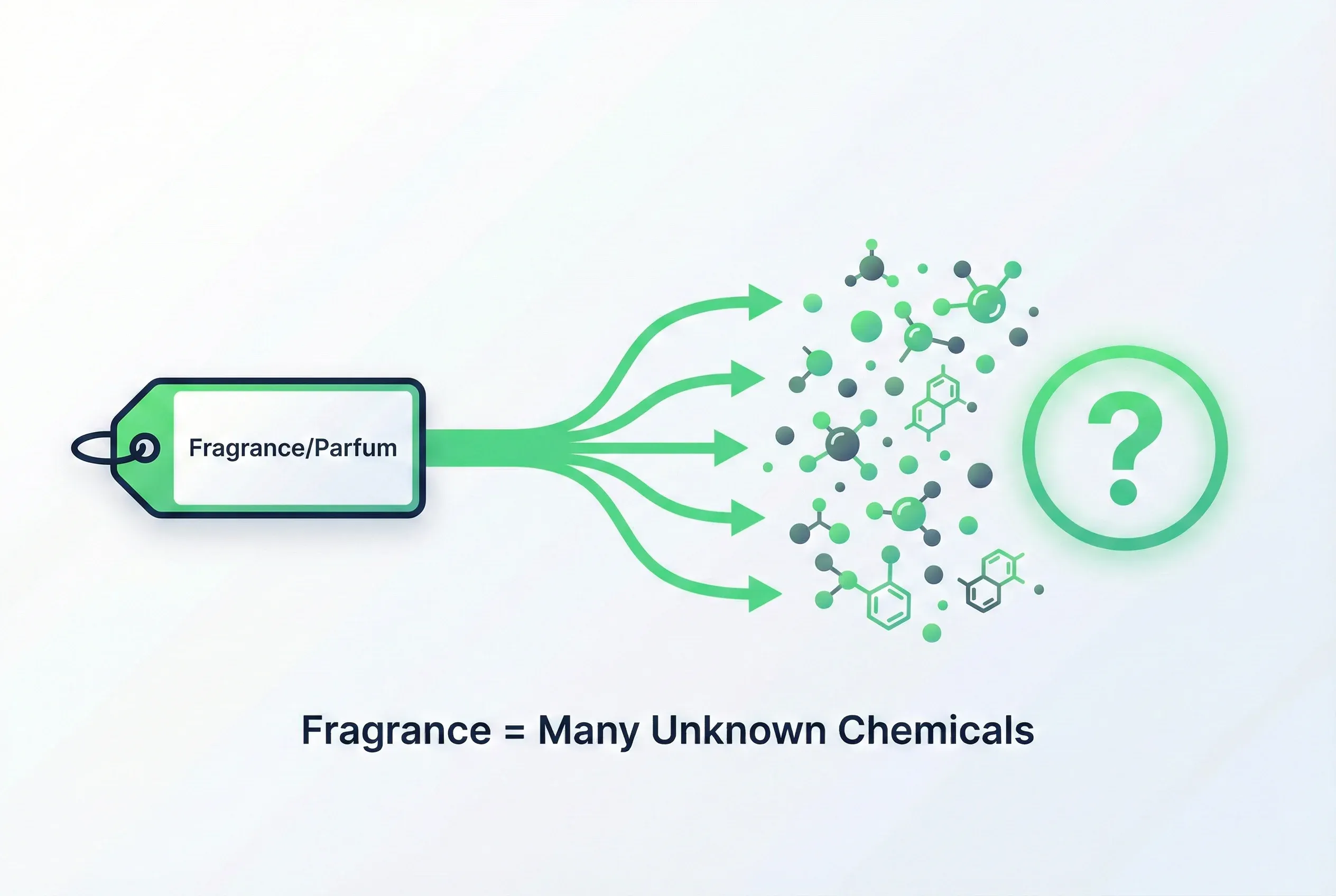
Fragrance (also listed as “Parfum”) is a catch-all term for a blend of scent chemicals used to make a product smell good or mask the smell of other ingredients. One “fragrance” can include dozens to hundreds of individual chemicals, and brands often don’t list them individually.
If you react to fragrance, the label usually won’t tell you exactly which scent chemical caused it — so avoiding the umbrella term (“Fragrance/Parfum”) can be the simplest strategy.
Quick label check (fastest way to spot it)
Look for these terms anywhere in the ingredient list:
- Parfum, Fragrance, Aroma, Perfume
- “Natural fragrance”, “Essential oil blend”, “Aromatherapy blend”
- Individual fragrance allergens that may be listed separately, such as Linalool, Limonene, Citronellol, Geraniol, Eugenol, Coumarin
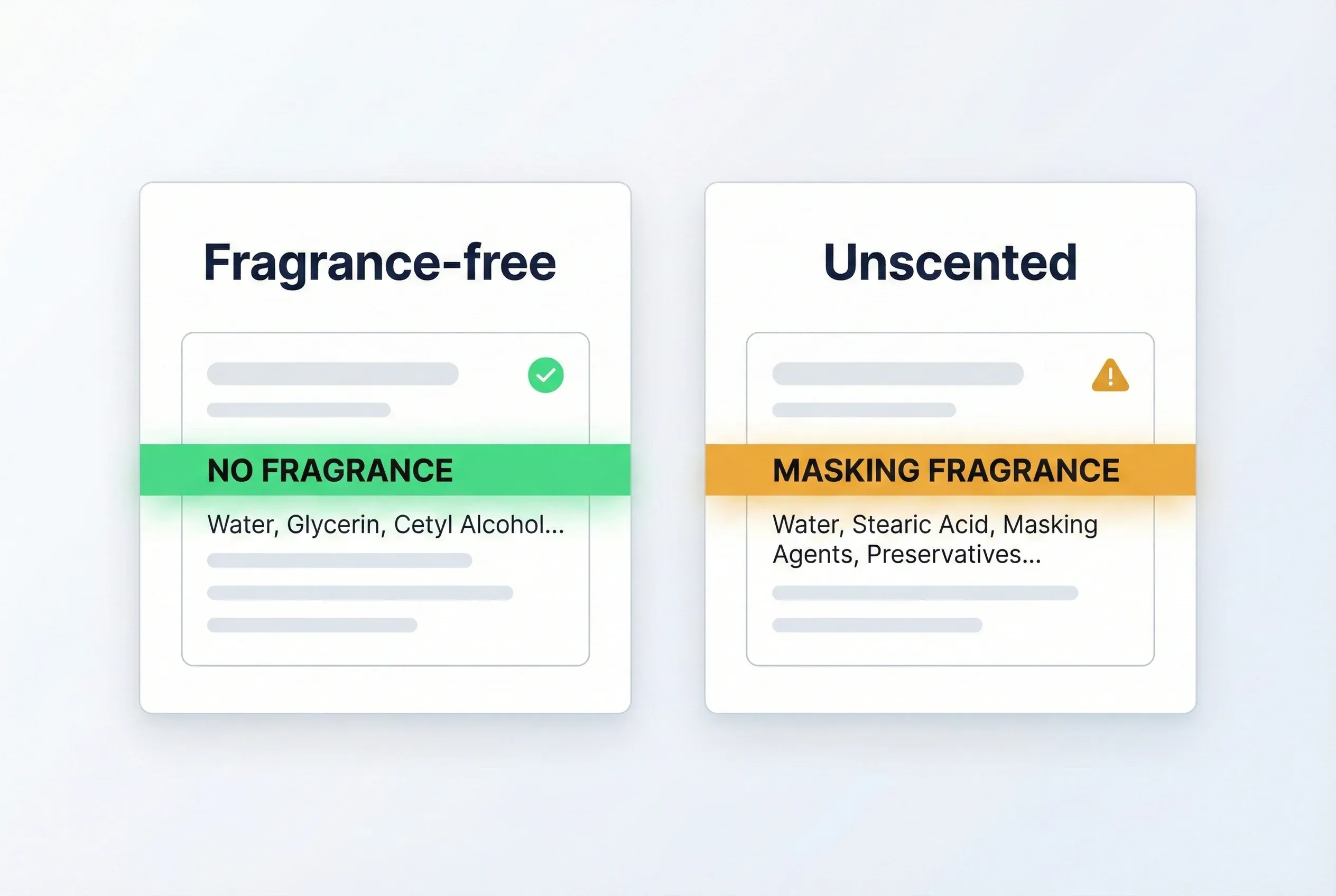
“Fragrance-free” vs “unscented”
“Unscented” does not guarantee fragrance-free. If you’re sensitive, look for “fragrance-free” and verify the ingredient list.
Where is fragrance commonly found?
Fragrance is extremely common in:
- Shampoos, conditioners, hair oils/serums
- Moisturizers, body lotions, face washes
- Deodorants and sunscreens
- Makeup
- Many “herbal”, “natural”, and essential-oil-forward products
Why does fragrance cause reactions?
Fragrance is a leading cause of allergic contact dermatitis in cosmetics. Two reasons it’s especially tricky:
- Sensitization: you can use a product for months/years and then suddenly react.
- Oxidation: some fragrance ingredients (like linalool/limonene) can become more allergenic as they oxidize over time (air exposure).
What can a fragrance reaction look like?
- Itchy rash, redness, or eczema flare-ups
- Burning/stinging, especially around eyes and mouth
- Sometimes headaches or respiratory irritation (for some people)
If reactions are severe or persistent, a dermatologist can confirm fragrance allergy via patch testing.
In Indian products 🇮🇳
In India, many products list “Parfum” without disclosing individual fragrance chemicals. Ayurvedic and “natural” lines often use essential oils (rose, sandalwood, jasmine) — these are still fragrances and can trigger reactions.
If you suspect fragrance is your trigger (simple plan)
- Start with leave-on products (moisturizer, sunscreen) — these sit on skin the longest.
- Switch to fragrance-free versions for 2–3 weeks.
- Introduce new products one at a time and patch test (inner arm) before using on face.
- If you still flare, consider patch testing with a dermatologist.
If a product smells strongly of flowers/herbs, it’s often essential-oil heavy. For sensitive skin, “boring” fragrance-free products are frequently the safest.
Safer alternatives
Look for products explicitly labeled “fragrance-free”.
Also helpful:
- Shorter ingredient lists
- No essential oils
- No “parfum/aroma”
Use Try Scan to flag common irritants without signing up. Create a free account when you want personalized allergen matching and saved history.
Why fragrance allergy is so common
Fragrance allergy shows up again and again in dermatology clinics for a few practical reasons:
- fragrance is present in many different product categories, so exposure adds up
- it is used in leave-on products like lotions and perfumes, which stay on the skin for hours
- many fragrances are mixtures of multiple chemicals, not a single ingredient
- oxidized fragrance chemicals can become more allergenic over time
The result is that people often react to the total load of fragranced living, not only to one bottle of perfume.
Places fragrance hides even when you are not buying perfume
If you are trying to reduce exposure, look beyond obvious scented products:
| Category | Why it matters |
|---|---|
| Shampoo and conditioner | run onto the face, eyelids, ears, and neck |
| Body lotion | large skin surface area and long contact time |
| Lip balm | frequent reapplication and exposure around the mouth |
| Deodorant | applied to warm, occluded skin |
| Baby wipes and wet wipes | repeated low-dose exposure |
| Laundry products | fragrance remains in fabric and touches skin all day |
This is why some people "do everything right" in skincare and still flare: the hidden source may be haircare or household fragrance.
A simple fragrance-reset plan
If you suspect fragrance is driving your symptoms, run a short reset rather than changing products randomly:
- Replace your moisturizer, cleanser, shampoo, and deodorant with fragrance-free versions.
- Pause perfumes, body mists, and essential-oil blends for 2-3 weeks.
- Use the same detergent and softener during the test period if possible.
- Reintroduce one fragranced product at a time only after your skin settles.
This sounds basic, but it works because it reduces noise. The goal is to learn whether fragrance load is part of the picture.
When patch testing is especially useful
Patch testing becomes more valuable when:
- you react to multiple unrelated products
- you flare on the eyelids, neck, or around the mouth
- you suspect both perfume and "natural" products
- you want to know whether fragrance mix, balsam of Peru, linalool, limonene, or specific hydroperoxides are involved
The exact diagnosis matters because some people are not reacting to every fragrance chemical. They may be reacting to a narrower subgroup.
Mistakes that keep fragrance allergy going
- removing perfume but keeping fragranced shampoo and lotion
- assuming "unscented" means fragrance-free
- switching to essential-oil products that still contain fragrance allergens
- forgetting that hair products touch the face, ears, neck, and pillow
- introducing three new "gentle" products at once
The more disciplined your reset period is, the faster fragrance becomes easier to confirm or rule out.
A realistic goal for fragrance-sensitive skin
You do not need a perfect, sterile life. You just need to lower the unnecessary fragrance load in the products that touch your skin most often. For many people, that means keeping skincare, haircare, and deodorant fragrance-free, then deciding separately whether perfume is worth it.
A practical first shopping list
If you are starting from scratch, the first categories worth replacing are:
- facial moisturizer
- cleanser
- shampoo
- deodorant
- lip balm
These are high-contact, high-frequency products. Fixing them first usually gives you more signal than starting with occasional makeup or body mist.
If you want a fifth category after those, choose shampoo before perfume. Hair products touch the skin more often than most people realize.
Another useful habit is to check pillowcases, towels, and laundry fragrance if facial or neck flares keep returning despite a cleaner skincare routine.
Fragrance avoidance works best when you treat it like exposure management, not perfectionism.
Small reductions across daily-use products usually matter more than dramatic changes in occasional products.
That is why a calm, fragrance-free baseline routine is such a powerful diagnostic tool.
FAQ
Are essential oils safer than fragrance?
Not necessarily. Essential oils can contain known fragrance allergens and can cause sensitization.
Can I be allergic to only one fragrance chemical?
Yes. That’s why avoiding the umbrella term (“Fragrance/Parfum”) is often easier than chasing individual triggers.
Related Ingredient Pages
Want to learn more about specific ingredients? Browse our detailed guides:
- Fragrance (Parfum) — catch-all label for scent blends
- Linalool — EU-regulated fragrance allergen
- Limonene — oxidizes, common fragrance allergen
- Citronellol — EU-regulated fragrance allergen
- Geraniol — EU-regulated fragrance allergen
- Eugenol — found in clove, strong sensitizer
- Cinnamal — found in cinnamon, EU allergen
- Coumarin — EU-regulated fragrance allergen
- Balsam of Peru — natural fragrance complex